Commercial kitchen grease interceptor service operates under strict mandates enforced by the City of Los Angeles Bureau of Sanitation (LASAN) Industrial Waste Management Division. Kitchen facilities producing fats,…
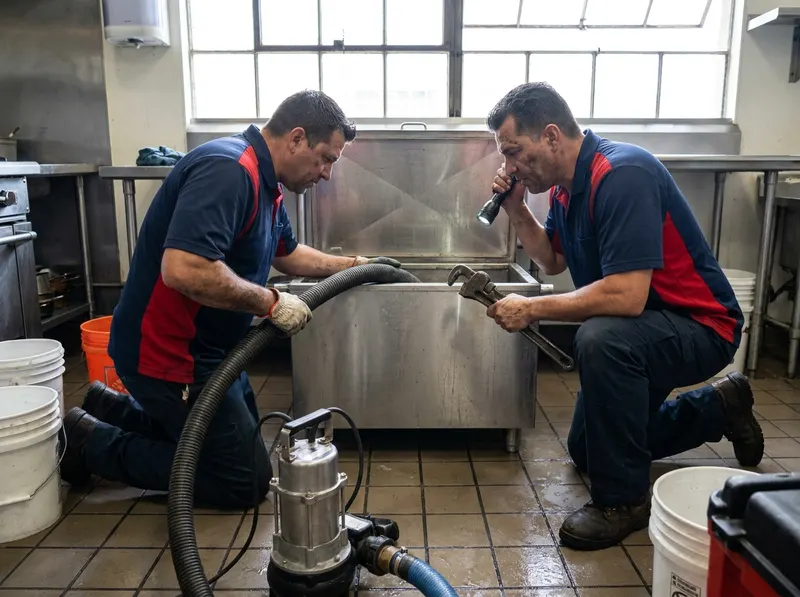
Commercial kitchen grease interceptor service operates under strict mandates enforced by the City of Los Angeles Bureau of Sanitation (LASAN) Industrial Waste Management Division. Kitchen facilities producing fats, oils, and grease must maintain hydromechanical grease interceptors (indoor floor units holding 20 to 100 gallons) or gravity grease interceptors (outdoor underground concrete vaults holding 750 to 2,500 gallons). In densely configured retail corridors along Wilshire Boulevard in Koreatown or Sunset Boulevard running through Silver Lake and Echo Park, indoor interceptors require routine pumping every 30 to 90 days. Under the standard municipal 25-percent rule, pumping is mandatory whenever the combined thickness of the floating grease cap and bottom settled solids exceeds one-quarter of the total liquid operating depth. Delaying service causes grease bypass into city sewer mains, which leads directly to city citations, municipal surcharges, and backline blockages that force health inspectors to halt food service operations.
Selecting between compact indoor hydromechanical trap servicing and large outdoor gravity interceptor pump-outs depends on kitchen discharge volume and plumbing footprint. Facilities in older multi-tenant spaces in Highland Park, North Hollywood, or Venice often rely on indoor stainless steel or cast-iron traps situated directly beneath three-compartment sinks and pot-wash stations. These compact units require manual baffle removal, physical side-wall scraping, and vacuum removal via portable extraction lines. In contrast, freestanding restaurants and commissary kitchens in Westwood, Brentwood, and Los Feliz typically operate 1,000-gallon exterior in-ground tanks located in rear service alleys or parking lots. Servicing exterior tanks requires heavy-duty vacuum tanker access, thorough rinsing of intake and outlet t-pipes, and verification of airtight vault lid gaskets to prevent sewer gas leaks from migrating toward outdoor patio dining zones. The operational trade-off centers on service frequency: indoor units take less space but demand frequent cleanouts, whereas outdoor interceptors handle massive gallon throughput over longer intervals but carry higher pump-out volumes and access constraints.
1. Intake and routing: Dispatch receives the kitchen address, liquid trap capacity, physical location (indoor under-counter or outdoor parking pad), and access constraints. 2. Vacuum extraction: Technicians run heavy-duty suction hoses to evacuate the liquid layer, stratified top grease layer, and bottom sludge down to the tank floor. 3. Mechanical scraping and inspection: Interior walls, inlet baffles, and outlet tees are scraped clear of hardened deposits, followed by an operational inspection of flow restrictors and lid seals. 4. Manifest logging: Detailed pumping logs and legal chain-of-custody disposal documents are issued directly to the kitchen manager to satisfy Los Angeles County environmental health records. Dispatch coordination is handled directly at (747) 330-2135.
Every job gets a firm, written price after a free on-site visit.
Tell us about your commercial kitchen grease interceptor service job in los angeles and we'll send a clear, written quote, usually the same day.
 LA Property Helpers