A pressurized hot or cold domestic water line running under a concrete slab foundation operates between 50 and 80 PSI across Los Angeles County. When shifts in expansive clay soils or long-term friction against coarse…
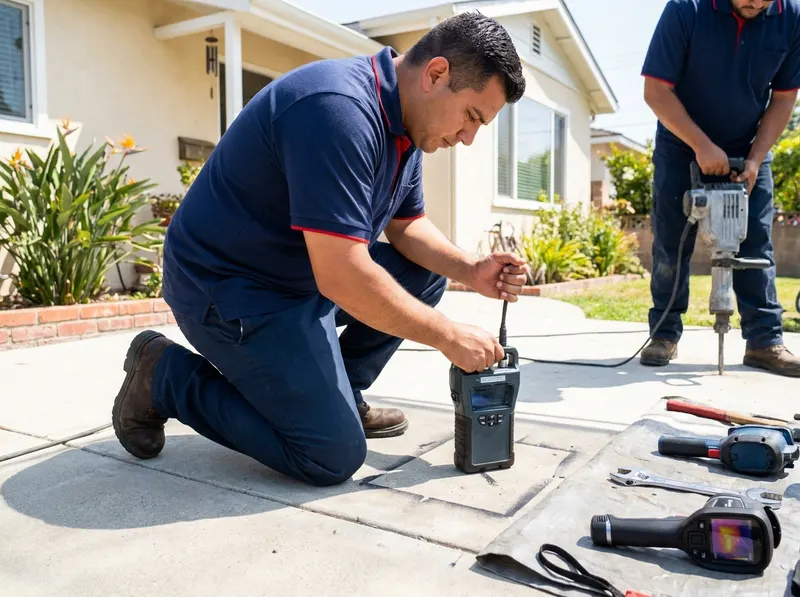
A pressurized hot or cold domestic water line running under a concrete slab foundation operates between 50 and 80 PSI across Los Angeles County. When shifts in expansive clay soils or long-term friction against coarse aggregate wear through a below-grade copper pipe, water migrates upward into flooring materials or escapes beneath the perimeter foundation. Properties in older foothill pockets near Los Feliz and Highland Park, along with mid-century tract houses in North Hollywood, frequently show hot spots on hardwood floors, damp carpet patches, or sudden spinning water meter dials. Rather than trenching an entire living space, acoustic listening discs and high-frequency ground microphones isolate the subterranean leak sound to a specific 12-by-12-inch footprint before any concrete removal begins.
Selecting a direct spot repair fits situations where an isolated pinhole leak develops along a straight section of accessible foundation flooring, preserving the rest of the domestic line. The direct approach requires breaking open a small concrete pocket with a rotary hammer, cutting away the compromised copper segment, and sweating or mechanically pressing a new Type L copper coupling into place. The primary trade-off involves invasive flooring disruption inside living zones like kitchens or hallways against the higher labor cost of a full overhead pipe reroute through attic or crawl spaces. When foundation structural integrity or finished Italian tile in a Brentwood estate precludes floor trenching, rerouting the pipe through interior wall cavities avoids breaking concrete entirely, though it requires opening drywall pathways.
1. Technicians verify line pressure loss by mounting a test gauge directly to an exterior hose bib or water heater supply connection.
2. Acoustic sensors and thermal imaging scan the finished flooring surface along the known distribution path to pinpoint subterranean temperature anomalies.
3. A technician opens a localized 18-by-18-inch aperture through the concrete slab down to the subsurface gravel bedding using a pneumatic chipping tool.
4. The damaged pipe section is extracted, reamed, and fitted with fresh hard-drawn copper and dual brazed couplings inspected under dynamic system pressure.
5. The soil excavation is backfilled with structural sand, followed by an aggregate concrete pour leveled flush with the subfloor plate.
Every job gets a firm, written price after a free on-site visit.
Tell us about your slab leak detection and direct repair job in los angeles and we'll send a clear, written quote, usually the same day.
 LA Property Helpers